Saturday, October 13, 2007

Katrina & the Racial Wealth Divide

Chaka A.K. Uzondu, an Education Coordinator at United for a Fair Economy, is part of the Racial Wealth Divide project, and has written:

Our task is clear. We have to build a movement for wealth equality and a people centered democracy. And the most pressing issue for such a movement must be racial justice and racial wealth equality.

Check out Uzondu's article here.

This is just one of the many resources accessible through the United for a Fair Economy website.

Check it out!

Friday, February 23, 2007

For Information on the National Emergency Management Summit in New Orleans:


NATIONAL EMERGENCY MANAGEMENT SUMMIT


The Leading Forum on Medical Preparation and Response to
Disasters, Epidemics and Terrorism

New Orleans Marriott
New Orleans, LA

March 4 - 6, 2007

Monday, August 21, 2006

When the Levees Broke: A Requiem in Four Acts

The broadcast of Spike Lee's Film "When the Levees Broke: A Requiem in Four Acts," begins tonight on HBO--
As the world watched in horror, Hurricane Katrina hit New Orleans on August 29, 2005. Like many who watched the unfolding drama on television news, director Spike Lee was shocked not only by the scale of the disaster, but by the slow, inept and disorganized response of the emergency and recovery effort. Lee was moved to document this modern American tragedy, a morality play witnessed by people all around the world. The result is WHEN THE LEVEES BROKE: A REQUIEM IN FOUR ACTS. The film is structured in four acts, each dealing with a different aspect of the events that preceded and followed Katrina's catastrophic passage through New Orleans. Acts I and II premiere Monday, August 21 at 9pm (ET/PT), followed by Acts III and IV on Tuesday, August 22 at 9pm. All four acts will be seen Tuesday, Aug. 29 (8:00 p.m.-midnight), the first anniversary of Hurricane Katrina. Read more.

Lee and his team selected close to 100 people from diverse backgrounds and representing a wide range of opinions to interview, including Governor Kathleen Blanco; Mayor Ray Nagin; residents Phyllis Montana LeBlanc, Kimberly Polk, Shelton "Shakespeare" Alexander and Rev. Williams; activists Al Sharpton and Harry Belafonte; CNN's Soledad O'Brien; and musicians Wynton Marsalis, Terence Blanchard and Kanye West.

Lee uses key elements of New Orleans' cultural legacy to illustrate its history of surviving against the odds. Long before Hurricane Katrina, New Orleans and its citizens developed coping strategies for dealing with tragedy. Its aboveground cemeteries are not only practical, but evidence of a people used to the sight of death. The traditional jazz funerals - musical parades that mourn death, and then celebrate life - serve as testament to that fact.
Read more of this overview.

Thursday, August 10, 2006

One-Year Review of Key Indicators of Recovery in Post-Storm New Orleans

New Report from the Brookings Institution:

A One-Year Review of Key Indicators of Recovery in Post-Storm New Orleans
by Amy Liu, Matt Fellowes, and Mia Mabanta
A review of dozens of key social and economic indicators on the progress of recovery in the New Orleans region since the impact of Hurricane Katrina finds that:

--Housing rehabilitation, and demolition, are well underway while the housing market tightens, raising rent and home prices.

--Across the city, public services and infrastructure remain thin and slow to rebound. Approximately half of all bus and streetcar routes are back up and running, while only 17 percent of buses are in use, a level of service that has not changed since January. Gas and electricity service is reaching only 41 and 60 percent of the pre-Katrina customer base, respectively.

--The labor force in the New Orleans region is 30 percent smaller today than one year ago and has grown slowly over the last six months; meanwhile, the unemployment rate remains higher than pre-Katrina... The unemployment rate is now 7.2 percent, higher than last August.

--Since last August, over $100 billion in federal aid has been dedicated to serving families and communities impacted by hurricanes Katrina, Rita, and Wilma. In the meantime, the number of displaced and unemployed workers remains high.

Thursday, July 20, 2006

New Katrina Report from Sage Foundation:


Notice from WORLDWATCH Institute:

New Report: In the Wake of the Storm: Environment, Disaster, and Race After Katrina
Zoe Chafe – July 17, 2006
This interdisciplinary report, written by professors from around the country, illuminates the environmental justice implications of Hurricane Katrina and its aftermath. The researchers focus on race disparities and linkages to environmental quality in the US, and the ways in which these disparities influence the preparation and relief efforts: before, during, and after a disaster. They provide positive examples of cities that prioritized development for poorer citizens during post-disaster reconstruction.

The report concludes with a simple but profound statement:

“Yet by allowing the weak link in the social chain—the poorest communities in the low-lying areas of the city—to be exposed, all of New Orleans was put at risk. By failing to value fenceline lives and communities, the risks rise for neighborhoods far from the first releases from a chemical incident.”

In the Wake of the Storm: Environment, Disaster, and Race After Katrina
By Manuel Pastor, Robert Bullard, James Boyce, Alice Fothergill, Rachel Morello-Frosch, and Beverly Wright. Supported by the Russell Sage Foundation.

Natural Disasters & Peacemaking--WorldWatch Institute

From the Worldwatch Institute:

With the number of disasters (and their devastating impacts) increasing worldwide, Worldwatch has initiated a major research and policy project on "un-natural" disasters. Many of the earthquakes, hurricanes, and floods that batter the globe are "un-natural disasters" because preventable human actions, including wetlands destruction, global warming, and population growth, turn natural hazards into humanitarian disasters.

The project looks specifically at disasters in conflict areas, proposing innovative ways to work towards peace during the relief and rebuilding processes. "While grim in its origin, post-disaster humanitarian action can be a powerful catalyst for overcoming deep human divides," says Michael Renner, Worldwatch Senior Researcher and Director of the Institute's Global Security Project. "But humanitarian impulses must be translated into tangible political change, or else lasting peace may not be achieved."

Visit our Disasters & Peacemaking portal for daily news updates and Worldwatch analysis relevant to "un-natural" disasters and their worldwide effects. The links will also be available via Worldwatch's listserv.

Recent Reports:

New Worldwatch Article on Peacemaking after Disasters - July 17

New Report: In the Wake of the Storm: Environment, Disaster, and Race After Katrina

Friday, July 14, 2006

Volunteer Joins Emergency Communities and Common Ground Collective to Help Residents in Arabi and the Ninth Ward of New Orleans

Excerpt from:
Hard Work In the Big Easy:
Vacationers Donate Time To Help Katrina Victims


By Eric Patel
Special to The Washington Post
Sunday, July 9, 2006
Yes, the Big Easy has become a lot harder to visit, especially if, like a growing number of travelers, you're looking to volunteer in a city severely damaged and surprisingly unhealed since Hurricane Katrina's devastation last August. It's a city that even has its own version of refugee camps. Within hours of touching down, I found myself ladling out scrambled eggs to a long line of residents at a makeshift "cafe" under a tent set up by aging hippies to feed homeless locals.

Even a cursory tour around New Orleans confirms the worst you've heard. The Lower Ninth Ward -- ground zero for the worst levee break -- is a virtually untouched, surreal landscape: splintered houses lying on cars, cars in trees, trees on houses, moldy rubble everywhere. In spring, seven months after the event, the entire area was silent -- no rumble of bulldozers, no excavators, no dump trucks.

In that bleak landscape, dozens of volunteer organizations have come to help -- getting people food, water or supplies or helping them reinhabit their homes and neighborhoods. They offer hope to locals and a blend of hard work, challenge and even adventure to volunteer vacationers.

During a 10-day trip here, I worked with two grass-roots nonprofit groups. The first, New York-based Emergency Communities, fed residents in the disaster zone of Arabi, a few miles east of the French Quarter (that site has since closed, although the group has operations in other areas in the same parish). The second, Common Ground Collective of New Orleans, helps homeowners in the impoverished Ninth Ward get back into their flood-destroyed homes and provides a variety of other services. Both are run on a shoestring and are fueled by a diverse and seemingly endless supply of volunteers.

To read more, click here

Most Members of Bush-Clinton Katrina Fund Advisory Committee Resign

Religious Leaders Quit Katrina Fund Panel

By RUKMINI CALLIMACHI
The Associated Press
Friday, July 14, 2006
NEW ORLEANS -- By all accounts, the group of nine was a religious powerhouse: Their ranks included rabbis, imams and ministers, including the man hailed by some as the next Billy Graham. But as of Thursday, seven of the nine religious leaders serving on a committee created by the Bush-Clinton Katrina Fund to disburse money to churches destroyed by Hurricane Katrina had quit their posts, claiming their advice was ignored.

Four out of nine board members confirmed their resignations on Thursday. Last week, two others--Bishop T.D. Jakes, the prominent Dallas megachurch pastor, and the Rev. William H. Gray III, former president of the United Negro College Fund--resigned as co-chairs.

Departing members of the interfaith advisory committee say the fund's Washington staff disregarded their advice, cutting checks for Gulf Coast churches without properly investigating the institutions.

To read more, click here.

Advisory Committee Co-Chairs Resign from Bush-Clinton Katrina Fund

3 Leaders Quit Effort To Aid Gulf Churches

By Darryl Fears
Washington Post Staff Writer
Thursday, July 13, 2006
The two most prominent members of an interfaith committee set up to distribute $20 million to churches affected by Hurricane Katrina abruptly resigned in recent days, saying their grant-making decisions were being undermined by the directors of the Bush-Clinton Katrina Fund.

Bishop T.D. Jakes and the Rev. William H. Gray III, co-chairs of Interfaith Advisory Committee, submitted their resignations late last week. Another committee member, the Rev. William J. Shaw, said by telephone that he resigned over the weekend; he declined to comment further.

Gray said board directors and staff members of the Katrina Fund -- established by former presidents George H.W. Bush and Bill Clinton -- would agree with the committee's recommendations in meetings and then do the opposite. He said that he, Jakes and Shaw resigned when the staff sent $35,000 to a church without their knowledge, then refused to explain why. That particular church had not been inspected to determine its need, Gray said.

To read more, click here.

Tuesday, July 11, 2006

New Books on Katrina and Its Aftermath


Here is an overview of the growing deluge of books on Katrina, by Jason Berry for NPR's "All Things Considered":
Now I am engulfed by the first tide of Katrina books. If you watched that disaster-coverage on television, you may wonder, "What's to know that we didn't see?"

A lot, in fact. About global warming, how cities live or die, the science of levees and stunning human dramas to shape our memory of the flood.

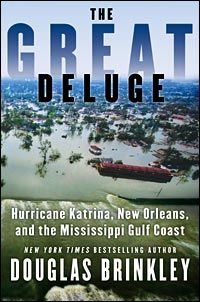
Two of the books reviewed by Berry are New Orleans Times-Picayune writer Jed Horne's Breach of Faith: Hurricane Katrina and the Near Death of a Great American City, and Douglas Brinkley's The Great Deluge: Hurricane Katrina, New Orleans, and the Mississippi Gulf Coast.


Also, on today's Fresh Air, Terry Gross interviewed Jed Horne about his book.

Terry Gross's May 10 interview with author Douglas Brinkley is here.

Friday, June 30, 2006

Take Action on Toxic Sediments in New Orleans

From Amnesty International USA's Action Center:
In the aftermath of Hurricane Katrina, 22 million tons of toxic sediment contamination and mold present serious health concerns for residents of New Orleans. Urge the EPA to fulfill its responsibility to ensure that News Orleans is safe and the public is protected from harmful environmental conditions created by the hurricane and subsequent flooding. Testing shows that the soil is contaminated with pesticides, arsenic, lead, industrial waste, and other cancer-causing chemicals. Without decisive action by the EPA, people will be at risk for serious and chronic health problems. Particular attention must be paid to low-income communities and communities of color, which are often situated near toxic industrial sites, and therefore suffer the greatest contamination.

Urge the EPA to meet their obligation to protect the people of New Orleans.
Environmental Justice for New Orleans
Environmental groups are sounding the alarm about the toxic chemical contamination in sediment and soil left in the wake of hurricanes Katrina and Rita. The hurricanes created 22 million tons of toxic debris, now dispersed throughout Greater New Orleans. Insufficient action has been taken to clean up the toxic contamination. No decision has been made as to whether there will ever be a coordinated government effort to rid storm ravaged communities of toxic substances.

To read more about the Struggle for Environmental Justice in New Orleans, and how you can help to support it, read more here.

Tuesday, June 27, 2006

Improving the Social Safety Net Before the Next Disaster

From the Urban Institute:
WASHINGTON, D.C., June 27, 2006--The structural complexity and inadequate benefits of four essential government programs made it hard for them to respond quickly and effectively to the deep-seated needs of people harmed by Hurricane Katrina, says a new Urban Institute study.

Katrina's scale and severity tested the intergovernmental funding arrangements, eligibility guidelines, and benefit standards at the heart of housing assistance, unemployment compensation, health care, and cash support programs. The storm's aftermath raised unsettling questions about whether these programs could reach storm-wracked residents of the Gulf Coast swiftly and fairly, and about state and local governments' incentives to address
victims' needs.

"Federalism after Hurricane Katrina: How Can Social Programs Respond to a Major Disaster?" explores the programs' responses to Hurricane Katrina, describes pre-disaster operations, specifies what made Katrina so hard to handle, and recommends better ways to respond to disaster in the future.
This paper is available here, and is part of the Urban Institute's After Katrina research series (http://www.urban.org/afterkatrina).

Thursday, June 22, 2006

Depression & Suicide Epidemic in New Orleans, Due to Collapse of Mental Health System

While the President and Congress continue to fail to respond adequately to the worsening public health emergency in New Orleans, as SUSAN SAULNY reported in a front-page article in yesterday's (June 21) New York Times,
New Orleans is experiencing what appears to be a near epidemic of depression and post-traumatic stress disorders, one that mental health experts say is of an intensity rarely seen in this country. It is contributing to a suicide rate that state and local officials describe as close to triple what it was before Hurricane Katrina struck and the levees broke 10 months ago.

Compounding the challenge, the local mental health system has suffered a near total collapse, heaping a great deal of the work to be done with emotionally disturbed residents onto the Police Department and people like Sergeant Glaudi, who has sharp crisis management skills but no medical background. He says his unit handles 150 to 180 such distress calls a month.

Cities and the Health of the Public: New Book


The essays commissioned for CITIES AND THE HEALTH OF THE PUBLIC (Vanderbilt University Press, to be published July 21, 2006) analyze the impact of city living on health, focusing primarily on conditions in the United States. With 16 chapters by 24 internationally recognized experts, the book introduces an ecological approach to the study of the health of urban populations.


For the Table of Contents and a sample chapter, click here.

Monday, June 19, 2006

Katrina Overview

For Review of the New Orleans Picayune's coverage of Katrina's aftermath, and a great animated map of how the city flooded, click here.

Friday, May 26, 2006

After Katrina: Building a Better Public Health System for the Future

June 9, 2006, 2:00 - 3:00 pm ET

As a follow-up to its previous March 31, 2006 Public Health Grand Rounds session, the UNC School of Public Health and the CDC are hosted their second National Satellite Broadcast & Webcast on June 9.
Ensuring access to primary care, promoting healthy behaviors, and designing healthy neighborhoods are among the goals that will contribute to the framework for a healthier Greater New Orleans. Community leaders representing all sectors from private businesses to non-profits to government agencies have claimed a stake in achieving these goals. The challenges they face include funding, coordination with other planning efforts, gaining support from stakeholders, and the uncertainty of repopulation.

The Public's Stake in Health Emergency Planning

On Tuesday this week in Washington DC, a joint U.S.-Canadian summit titled Disease, Disaster and Democracy: The public’s stake in health emergency planning was hosted by the University of Pittsburgh's Center for Biosecurity in collaboration with the Canadian Policy Research Network; The Center for Science, Technology and Security Policy, the American Association for the Advancement of Science; and the National Consortium for the Study of Terrorism and Responses to Terrorism (START), a U.S. Department of Homeland Security University Center of Excellence.
The purpose of the summit was to advise government, public health and disaster management leaders on the feasibility and benefits of actively engaging citizens in planning for large-scale health emergencies, in anticipation of the ethical dilemmas posed by a scarcity of life-saving medical resources and the logistical difficulties of protecting the well and caring for the sick in large numbers.
The keynote address on "Why the Public’s Trust and Help Matter in Health Emergencies" was delivered by Dr. D.A. Henderson, of the Center for Biosecurity and former Dean of the Johns Hopkins University School of Public Health.

The panel sessions that followed outlined the benefits to government of citizen engagement along with an inside look at current citizen engagement programs, by representatives from the U.S. and Canadian government organizations, and grassroots and faith-based organizations.

Afternoon roundtable exercises focused on pandemic flu, specifically addressing the issues of determining which populations would receive the flu vaccine and the healthcare system’s capacity to manage the sick and the healthy, while maintaining essential medical services. Participants in roundtable discussions included representatives from federal, state and city U.S. government, Canadian government, voluntary and humanitarian relief organizations, hospital administration, community organizations and businesses.

Friday, May 12, 2006

Help Keep Louisiana's Gov from Selling Out Displaced Citizens


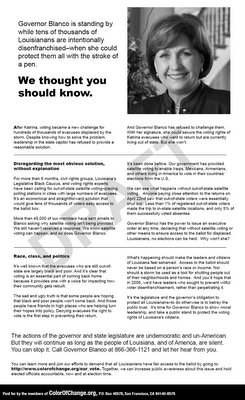
Click on the image to view full-size poster ad developed by ColorofChange.org.

You can learn more about the efforts of Color of Change to support Louisiana's displaced citizens here.

To support satellite voting, and to keep the Government of Louisiana from disfranchising its displaced citizens, call Governor Blanco at 866-366-1121.

Thursday, April 13, 2006

Save Charity Hospital! Health Care Catastrophe in New Orleans

From New Orleans IndyMedia:

On March 25, 2006, community members, doctors, residents, medical students, nurses, hospital employees, politicians, and political activists rallied outside of New Orleans’ Charity Hospital to protest the closure of this esteemed public institution. Considered the oldest continuously running public hospital in the country, Charity has cared for thousands of members of the New Orleans community for two centuries. These New Orleans residents are now largely without access to healthcare and have been forced to rely entirely on understaffed emergency rooms for basic health needs, such as monthly prescriptions and routine medical complaints. This shift has caused a healthcare catastrophe in the New Orleans metropolitan area.

Democracy Now Being Denied to Displaced New Orleanians

This Democracy Now! broadcast from April 10 provides good overview of what Displaced New Orleanians are thinking about the upcoming New Orleans elections....

What's Wrong With this Voting Picture?

Compare the NY Times map from Oct. 2, 2005, which indicates the total number of evacuees in states outside Louisiana (more than 700,000) with the recent New Orleans Times-Picayune map of the number of people who had requested absentee ballots by last Friday (less than 11,000), and you may ask, "What is wrong with this picture?" The states of Texas and Alabama received over 100,000 evacuees, yet only 3557 requests from Texas and a mere 315 from Alabama had been received by last Friday.

In the run-up to city elections that will determine the future of New Orleans, there are signs that New Orleans evacuees may be subject to a virtual disfranchisement of gigantic proportions. With less than two weeks remaining before the election on April 22, records available at NOLA.com indicate that less than 15,000 of the more than 500,000 evacuees scattered across the country have requested absentee ballots.

As ColorOfChange.org has written, "Everyone watching knows what will happen if elections go forward without a change" in this situation: "the Black vote will be suppressed and the ability for Black New Orleanians to claim their future [will be] compromised. During Iraq's election, the U.S. government provided polling places in U.S. cities with large numbers of Iraqi-Americans. Why won't it do the same for thousands of mostly Black displaced New Orleanians?"

If you think there's something wrong with this picture, there is something you can do: Sign this petition to Governor Blanco, and demand satellite voting for the citizens of the New Orleans diaspora:

Setting up satellite voting centers outside the State of Louisiana in areas with large numbers of displaced residents is a reasonable, effective way to improve their access to voting rights. Please make your voice heard, and help to ensure that all New Orleanians have equal access to voting and being involved in determining the future of their city.

In addition to signing the petition above, please Call Gov. Blanco's office at (866)-366-1121, (225)-342-0991, or (225)-342-7015. Tell the person who answers that you're calling on Governor Blanco to provide satellite voting centers for displaced New Orleanians outside the State of Louisiana, even if it means postponing the April 22nd election.

Monday, April 10, 2006

9th Ward ACORN Community Forum Draws 250 Residents

On March 26th, 250 residents of the 9th Ward in New Orleans participated in a community planning meeting co-sponsored by the Cornell University Department of City and Regional Planning, the Louisiana State University School of Architecture, and State Representative Charmaine Marchand.

Residents came to register their intent to return and to voice their concerns about rebuilding. During the day, residents formed committees to work on rebuilding plans, and they met directly with planners and other residents about community needs.

Also present were City Council member Cynthia Lewis and City Council President Oliver Thomas, who both committed to authoring a city ordinance making it law for anyone with a city contract to pay a living wage.

In addition to discussing the future, 9th Ward residents documented their stories and contributed to the design of a memory map to record pre-Katrina 9th Ward neighborhood characteristics and experiences. An Information Center provided updates and assisted residents in local support services, and ACORN tax preparers were on hand to prepare taxes for free while residents participated in the meetings and workshops.

Saturday, April 08, 2006

Who is Killing New Orleans?

Mike Davis has written an excellent essay with this title, published in the April 10 edition of The Nation. This essay examines the politics of power interfering with recovery efforts in New Orleans. Check it out!

Thursday, April 06, 2006

Hurricane Katrina Accountability and Contracting Reform Act (H.R. 3838)

The Hurricane Katrina Accountability and Contracting Reform Act (H.R. 3838)
(http://thomas.loc.gov/cgi-bin/bdquery/z?d109:h.r.03838)

A bill to create an anti-fraud commission to prevent wasteful spending, to ban abusive contracting practices, and to increase contracting transparency. This commission would help ensure that the government money going to relief efforts actually goes to relief efforts. The GAO and The Washington Post have already reported severe money mismanagement, and it seems it would be in the best interests of the Gulf Coast if this stopped.

Who to call: Rep. Candice S. Miller (10th District, MI)
Phone: (202) 225-6465
Website: http://candicemiller.house.gov/

What to say: 1. This bill is critical to the speedy recovery of the Gulf Coast.
2. No action has been taken on this bill since September, 2005. 3. As a concerned citizen of Michigan, I would like to see the House take action to approve this bill immediately.

Grassley-Baucus Emergency Health Care Relief Package (S.1716)

--Key Legislation and Contact Information, Courtesy of Students at the UNC School of Public Health

The Grassley-Baucus Emergency Health Care Relief Package (S.1716)
(http://www.congress.gov/cgi-bin/bdquery/z?d109:SN01716:)

This legislation would provide Katrina survivors with health coverage wherever they are now located. A simplified eligibility and enrollment process would be created to enroll people from federal disaster counties in Mississippi and Alabama and federal disaster parishes in Louisiana into Medicaid. It would also extend to people who live elsewhere in the affected states who have lost their jobs since Hurricane Katrina. This coverage would encompass everyone with income below the poverty level, pregnant women and children with income up to twice the poverty level. Once enrolled, Katrina survivors who are located in other states would receive Medicaid as though they were Medicaid enrollees in that state. This means no new systems or rules for health care providers or states. The federal government would pay all of the cost of providing Medicaid to covered Katrina survivors in any state in which they are enrolled. This would continue for five months with a potential five month extension. The federal government would pay the full cost of Medicaid coverage for all residents of Louisiana, Mississippi and Alabama through December 2006. In addition, the proposal would ensure that no state would experience a decrease in its federal matching rate in 2006. A new, federally administered Disaster Relief Fund would offset uncompensated care costs that health care providers have incurred caring for Katrina survivors.

Who to call: Sen. Carl Levin (MI)
Phone: (202) 224-6221
Website: http://levin.senate.gov/

Sen. Debbie Stabenow (MI)
Phone: (202) 224-4822
Website: http://stabenow.senate.gov/

What to say: 1. This bill is critical to the health and well-being of Katrina survivors.
2. No action has been taken on this bill since September, 2005.
3. As a concerned citizen of Michigan, I would like to see the Senate take action to approve this bill immediately.

Friday, March 31, 2006

UNC Webcast: Lessons from Katrina on Emergency Preparedness and Response

"Learning from Katrina: Tough Lessons in Preparedness and Emergency Response"

As part of the CDC and UNC School of Public Health's "Public Health Grand Rounds" series of public webcasts, today's program was especially valuable for providing perspective on the public health response to Katrina, as viewed by the public health and hospital officials who were directly involved in coordinating the local and state public health response in Louisiana. This webcast features brief interview segments with six members of the Louisiana Department of Health and Hospitals, as well as representatives from the Louisiana Hospital Association, the Louisiana Public Health Institute, and the New Orleans Health Department.

Overall, this program is especially valuable for stressing the need for forms of local planning and preparedness training that build strong relationships and patterns of behavior among local first responders as a foundation for effective communication and coordination of improvised and creative responses to the unexpected aspects of any disaster.

As posted on the website, the six "Objectives" of today's program were to:

1. Describe three communication problems that challenged the Katrina disaster response.
2. Identify three concerns in evacuating vulnerable populations from a disaster area.
3. Describe two strategies to prevent infectious disease outbreaks.
4. Describe the public health response when hospital systems are overwhelmed. 5. Describe two factors that impacted coordination between federal, state, and local public health partners.
6. Discuss the need to anticipate behavioral reactions to a disaster.

The UNC Public Health Grand Rounds website makes this webcast available for viewing, and for the next week until April 7 also has an on-line Post-Program Discussion Forum available for addressing questions raised by the program.

The next Public Health Grand Rounds Program is scheduled for June 9 and will be a follow-up to today's program, and is titled "After Katrina: Building a Better Public Health System for the Future."

Sunday, March 26, 2006

LIFE OUT OF CONTEXT

Writer Walter Mosley recently published a short book that challenges all Americans to quit being satisfied with the limited options offered by our two dominant political parties. Life out of Context offers a "Proposal for the Non-violent Takeover of the House of Representatives" that should be read by every citizen concerned about what is and is not happening to support the Gulf Coast, the evacuees, and the next victims of our current government's strategic policy of neglect.

Mosley concludes with these words:
Economic globalism has pressed many lives out of context. It's about time we push back.

Wednesday, March 22, 2006

What Will It Take?: Seven Months After, and Still Waiting....

Today's front-page article in the New York Times, "Evacuees' Lives Still Upended Seven Months After Hurricane: Burdens and Frustration Linger," only further emphasizes the many reasons people across this country need to be organizing in new and dramatic ways to demand more adequate government support for evacuees and the community organizations and people of the Gulf Coast who continue to suffer from insufficient resources and support seven months after Katrina.

The President has made clear that he would rather continue to support tax cuts for the wealthy and an indefinitely extended war in Iraq, than adequately support the needs of the citizens of this country. If anything is to change, concerned citizens across this country need to organize in dramatic new ways to demand greater government accountability and response at all levels.

Why haven't there been major protests in front of the White House, and in cities across the nation, to castigate the immorality and unaccountability of a federal government that is willing to continue to invest billions of our tax dollars in a failed strategy in Iraq, while the citizens of this country are not being adequately served? Why aren't Washington politicians getting harried by a perpetual barrage of letters, emails, and phone calls from angry constituents demanding major changes of government policy to provide more robust support for Gulf Coast recovery?

Why could President Bush at his Washington press briefing yesterday get away with laughing and joking with the press, without being called repeatedly and persistently to account for the terrible moral wrongs of an executive policy more dedicated to providing tax cuts to the wealthy than to supporting decent health care and housing for the citizens of the Gulf Coast scattered across this country?

Where are the moral and political outrage required to demand a fundamental change in this administration's policy priorities?

Are the people and press of this country sleepwalking through the history of the present? Would the press rather brown-nose and laugh with this President than risk this President's displeasure by demanding that his administration change its policy priorities to serve the citizens of this country most in need?

If the continuing disastrous failure of response (of government, press, and policy) after Katrina is not enough to rouse the citizens of this nation to call for fundamental changes in this administration's priorities, what else will it take? Another Katrina, or worse?

The change that is needed will not wait until the next Presidential election. This year's congressional elections can be part of a change strategy, but even these elections are still 7 months in the future.

The citizens of the Gulf Coast need and deserve greater support from their/our government NOW, not seven months from now. The pressing question is: What will the citizens of this country do NOW to make sure our fellow citizens get the support they need?

Nothing much will change unless every one of the politicians up for reelection in November is clearly put on notice that he/she will not be reelected unless we begin to see major changes in policy priorities.

While the evacuees and residents of the Gulf Coast continue to suffer, no politician should feel secure about reelection.

So long as the evacuees are insecure, no politician should rest secure in office.

Wednesday, March 15, 2006

Future National Preparedness at Stake

According to the Associated Press, Senator Lieberman said that "nothing less than the future preparedness of our nation to respond to a terrorist attack or another catastrophic natural disaster is at stake" in what we learn from our failures post-Katrina.

That "Future" will be here within three months when the next hurricane season arrives--

Meanwhile, Congress is still busy writing reports. While The U.S. House of Reps. released its Katrina report A Failure of Initiative on February 15, the Senate committee on Katrina is only now beginning to wrap up its "investigation" into the failed planning and response to the hurricane. What will the Senate report be titled?

Monday, March 13, 2006

Rationale for Community-Based Participatory Process of Disaster Recovery

The Natural Hazards Center at the University of Colorado has produced an excellent resource on Holistic Disaster Recovery for use by all citizens, community-based organizations, and government leaders interested in Building Local Sustainability After a Natural Disaster. This publication gives explicit attention to:

--Engaging Participatory Processes in Disaster Recovery, with emphasis on:
--Using Disaster Recovery to Maintain and Enhance Quality of Life
--Building Economic Vitality into Recovery
--Promoting Social and Intergenerational Equity During Disaster Recovery, and
--Protecting Environmental Quality During Disaster Recovery.

IF WE FORGET or Turn Away...

Michael Eric Dyson concludes his book Come Hell or High Water: Hurricane Katrina and the Color of Disaster with the following warning:

The only way Katrina can be kept from becoming a passing moment of self-reflection along the national path to even more carnage is if we continue to tell the truth about poverty, race, class, environment, government, the media, and our culture. Memory warfare pits us against the forces of cultural, racial, and class amnesia.... If we forget, then poor people of color become little more than fodder for the imperial imagination of a nation that has exploited them and thrown them away. God forbid we count ourselves in that number (p. 212).

Louisiana's Coastal Tribes Appeal for Help

Louisiana's Coastal Tribes have been calling for aid ever since the devastation of six months ago, but have been receiving little help. See the website of Four Directions Solidarity Network--

Oxfam Report: Recovering States? The Gulf Coast Six Months After the Storm

According to a new report by Oxfam America titled Recovering States? The Gulf Coast Six Months After the Storm, state and federal agencies are continuing to neglect poor communities six months after Hurricane Katrina displaced more than 800,000 people from their homes:

"Despite critical reports and investigative hearings of government failures, despite the flurry of commitments to confront poverty in the U.S.--six months after Katrina, little has changed," said Minor Sinclair, director of Oxfam America's Regional Office. "It's unconscionable that the same vulnerable people abandoned in the height of the storm could again be neglected in the recovery. There are still thousands of people who don’t have a place to live and don’t have answers to the most basic questions about their futures in the Gulf Coast."

Rebuilding New Orleans

New Orleans residents are not waiting for help from a delinquent federal government to begin the work of rebuilding. Residents of many neighborhoods are meeting to discuss their needs and plan their next steps in the stuggle to rebuild their lives and homes....

Tuesday, March 07, 2006

So What Can We Do?

What can the PHAST students of the School of Public Health do now to begin to build sustainable working relationships upon our one-week experience in the Gulf Coast? What can we do to make sure that our brief trip to the Coast becomes the basis for providing sustainable assistance to the people and organizations of the Gulf Coast calling out for assistance from the rest of the country?

In New Orleans we met some of the wonderful people who are trying to save and rebuild this city, in spite of all the challenges they face, and the slow and largely inadequate governmental response on all levels--local, state, and federal. We met and talked with Dr. Mary Abell of the St. Thomas Clinic, Kimberly Richards of the People's Institute for Survival and Beyond, and Adam Becker of the Louisiana Public Health Institute. But we also met with local citizens who shared with us their rich stories of survival and struggle. (I will note some of these stories in future entries).

One clear thing I learned from my time in New Orleans is that since government has been so slow and inadequate in fulfilling its responsibilities to support and assist all citizens in their rebuilding efforts, it has been the work of citizens and community organizations that has made it possible for New Orleanians to nurture the hope that the city can rebuild, and do so in a way that addresses the racial and class inequities that have plagued its past, continue to plague its present, and threaten its future.

You need only compare the rebuilding efforts going on in the white or wealthy areas of the city with the relative lack of attention to the hardest hit black portions of the city (especially the ninth ward) to note the tremendous disparities and inequities evident in the current rebuilding effort. Parts of the lower ninth ward look like they have not been touched since the flood waters burst through the industrial canal in August 2005. Decimated houses still sit astride the same streets into which the flood waters moved them over six months ago.

If the rebuilding of New Orleans is to occur in ways that address class and racial inequities, instead of preserving or aggravating them, there is much citizens of the rest of the country need to do to insure that the people and organizations of New Orleans and the Gulf Coast get the resources they need for a just and equitable rebuilding. As students of the UM School of Public Health, we can participate in this process over the weeks ahead by helping our School and University begin to build the kind of sustainable relationships with the people and organizations of the Gulf Coast that will support equitable rebuilding efforts.

As individuals alone, each of us may be at risk of feeling overwhelmed by what we witnessed, and feel frustrated about how little we can do to address the great needs of the region. But if we work together, we can each contribute something positive to the work of rebuilding by uniting our individual efforts--however small they may seem--to help our School and University develop the kind of sustainable relationships that will support the work of the people and organizations of the Gulf Coast dedicated to a just and sustainable future for all the people of the region. This is, at least, what I hope PHAST and other interested students at the School of Public Health will begin to work toward in the busy short weeks ahead before the end of the term.

A Disaster of Government and Citizenship?

I reacted to what I witnessed on the TV screen after Katrina with a deep sense of betrayal because I recognized that the deaths we were witnessing were not the result of any natural disaster, but a disaster of our own making--a disaster of government stemming from a long-developing failure of policy vision and policymaking--a disaster stemming from a fundamental failure of citizenship by all Americans. For me, the voices of the people abandoned to death or hunger after Katrina screamed of the failures of policy and political vision that had been preparing this disaster for many long years, and that will continue to prepare many disasters to come until we, as citizens, change this country's policy of wilful blindness and neglect toward the poor and uninsured.

I take our current and ongoing failures of government initiative personally because I know we can do better, in this culturally and materially wealthy country, than this. We not only can do better, we must do better--if we want a future for this country that will be worthy of what the citizens of this country have to offer each other and the rest of the world.

As I prepare to head to New Orleans tomorrow, I've begun to read Michael Eric Dyson's new book, Come Hell or High Water: Hurricane Katrina and the Color of Disaster. Dyson begins by discussing the long history of our nation's blindness to the structural politics of race and class, along with the short-sighted practices of policymaking, that long before August 2005 paved the way for the failures of response to Katrina (which continue six months later).

Most valuable in Dyson's opening chapter "Unnatural Disasters" is his move to look beyond the immediate failures of government to the failures of citizenship and civic responsibility that made the response and policy failures not only possible, but inevitable. Dyson underlines the naivete of the majority of white middle-class and wealthy Americans who were surprised to see their government leave behind the most vulnerable poor and black citizens of Louisiana and Mississippi, and he indicts a culture of "blissful ignorance" that keeps so many Americans "deliberately naive about the poor while dodging the responsibility that knowledge of their lives would entail."

And Dyson quickly moves to the heart of the matter when he underlines the blissful escape from responsibility embodied in the framing of what happened to the Gulf Coast six months ago as a "natural disaster." When we frame what has happened to a million of our fellow citizens over the last six months as the result of a natural disaster, we can be angry about what happened without feeling responsible for what happened:


"We are thus able to decry the circumstances of the poor while assuring ourselves that we had nothing to do with their plight. . . . We are fine as long as we place time limits on the origins of the poor's plight--the moments we all spied on television after the storm, but not the numbing years during which we all looked the other way. But we fail to confront our complicity in their long-term suffering. By being outraged, we appear compassionate. This permits us to continue to ignore the true roots of their condition, roots that branch into our worlds and are nourished on our political and religious beliefs" (4).

Dyson then moves immediately to restating a basic fact: "There are 37 million people in poverty in our nation, 1.1 million of whom fell below the poverty line in 2004."

Meanwhile, as we all know, our federal government has dedicated itself for more than four years now to enriching the wealthiest among us with tax cuts, while cutting what little remains of the social safety net of government programs that were created once upon a time when the citizens of this country still understood what it meant to use government as a common instrument for helping all Americans to share with each other the responsibilities and privileges of being citizens.

As I have watched the political game of failure and blame play itself out over the last six months in Washington, my long-developing fears and despair about the future of this country have only been compounded. I fear we now live in a country where the most advantaged individuals, who have gained the most from living and doing business in this country, no longer feel they owe any duty or responsibility to either their fellow citizens, or the social infrastructure (which includes public health), that has made their success and wealth possible. Why else would they accept increasing tax cuts while the least advantaged of their fellow citizens go without health care and fight their wars overseas? And based on the way those with the most power in our society and government have been devoting ever-increasing fractions of the tax dollars some of us pay (along with the lives or our fellow citizens) to fighting wars overseas while ignoring the poverty and suffering that increases among our own fellow citizens, I have lost faith in our current national "leadership" (of both parties).

My only hope (and this is why I am going to New Orleans this week) in the future of this country is that we can learn from each other as citizens to allow Katrina to teach us all to be citizens of a common country. 9/11, for all its trauma, and for all the media-inspired celebrations of patriotism that followed, apparently failed to do this. Otherwise we would not be allowing our government leaders to continue to abandon our fellow citizens as we have been since 9/11. While near 3000 died that day, how many more of our citizens have died since then of poverty and lack of access to proper health care treatment? How many more have died from despair at watching their government leaders talk of promoting democracy in the rest of the world while the most basic of human services are denied them at home?

And by abandoning our fellow citizens, I mean not just those from the Gulf Coast, but those 37 million in poverty (including the 1.1 million new poor in 2004), and the 46 million of our fellow citizens without health insurance, all over this country, who are suffering because of a national policy of wilful neglect and failure. Until we all, as citizens of this country, take responsibility for summoning the collective will to create a government and a policy structure worthy of the people of the United States, I will continue to live in despair of this country's future--for the poverty of other Americans is my poverty. Until we begin as a nation to understand and feel the poverty of others as our own, we will not escape our current national state of spiritual impoverishment. And this spiritual impoverishment is already showing its very material hand.

For no matter how much American citizens like to criticize their government when it does badly, and take it for granted when it serves us well, our government and our policy are what we make of them, for better or worse for all of us. Our government's failures (at local, state, and federal levels) to serve the most vulnerable of our fellow citizens only underline our own failures as citizens to create the kind of government that will not leave our fellow citizens (us) behind in their (our) times of need--

And so I continue to take our ongoing failures of government policy and vision personally. We can do better, in this rich country, than this. We owe it to ourselves and to each other, as citizens, to make sure our government does better in the future. We owe it to ourselves and each other to join together as citizens to demand new political vision and new policy frameworks for addressing the suffering of our fellow citizens. And so I am going to New Orleans to learn from, and contribute to, what the citizens of New Orleans are already doing to rebuild and demand better of this country, and better from all of us.

And lest we make the mistake of thinking that doing better for the citizens of the Gulf Coast would demand that we all become selflessly noble and philanthropic, we need simply to remember that a country filled with increasing numbers of poor and impoverished people, without hope, and living in despair, can not long continue to be a prosperous and successful country on any level. We should demand of ourselves that we do better for the citizens of the Gulf Coast because one day we will depend on the citizens of the Gulf Coast to do their part to help the rest of us in our time of need. This is the meaning of citizenship in common.

The great Mississippi flood of 1927, and the government failures of response after it, preceded the Great Depression by only a few years. But the market, policy, and political failures that brought on the Depression were already firmly in place by 1927. One need only compare the economic policies of Coolidge during the 1920s to those of today to begin to see the much larger failure toward which we may be heading in an era which seems to think there is little reason to pay attention to the lessons the history of the past century of human market failure and war might have to teach us.

A country of people too self-involved to summon the collective will to demand that its government insure the health and well-being of ALL its citizens can hardly serve as a good model of democracy to the rest of the world. Such a country has only a poor future ahead of it. The future we help (or do not help) to build in the Gulf Coast will mirror the future we are building (or not) for the rest of the country. Perhaps the best way we can begin, as a people, to earn back the respect of the rest of the world for this country is to show that we can insure the well-being of our own fellow citizens, beginning with those on the Gulf Coast.